Guernsey in this period
After 1204 Guernsey remains loyal to the English Crown while preserving Norman law and institutions. The Crown reorganises former Norman lands on the island.
Imagine a lord in the year 1204, with fields in Normandy and fields in Guernsey. Until that year he served one master, the Duke of Normandy, who was also King of England. Now the duke had lost Normandy to the King of France. Our lord had to decide which king he would serve, and either answer would cost him part of everything he owned.
The main branch of the d'Annevilles decided for France. Their oldest lands were there, in the Val de Saire, with their churches, their tenants and the parishes that carried their name. The French king left them in possession and gave them employment. In Guernsey, however, their fief passed to the English Crown.
A king who receives a fief sooner or later gives it to a man he trusts, and in exchange he gains a loyal servant in a place that matters. Anneville was the largest fief of an island that faced the French coast. In 1248, after more than forty years in the hands of the Crown, Henry III gave it to William de Cheney. The new lord kept the old name. He and his heirs made Anneville the heart of the greatest estate in the island, and they kept it for more than two centuries.
About these lines: a narrative reconstruction written in the manner of C. Northcote Parkinson (1909–1993), Seigneur of the Fief d'Anneville from 1964 to 1987, historian, and author of the novels of Richard Delancey, a Guernsey sailor. Parkinson did not write them and they are not a historical source. They invent no characters and no speeches: every fact comes from the room above, and words in quotation marks are quoted from the documents cited there.
 Arms associated with Anneville: ermine, a fess gules
In 1204 King John of England lost mainland Normandy to Philip Augustus, King of France. The Channel Islands stayed with the English king. Every great lord who held land on both sides of the sea now had to choose one king. The main branch of the d'Annevilles, in Normandy, chose France (on a branch that may have stayed with the English king, see Room 03). J. B. Payne, writing of the island lords in 1859, lists D'Anneville among those who "disobeyed the injunction, and became vassals of France."
France rewarded the choice. De La Chesnaye des Bois records that Guillaume d'Anneville, son of Samson, served John, the last Duke of Normandy, and then entered the service of Philip Augustus. He was listed among the gentlemen confirmed in their possessions after the French conquest of Normandy.
In Guernsey the same choice had a price. A lord who sided with France broke faith with the English king, his lord for the island lands. In law this was felony, and the island lands were forfeited to the Crown. The royal records list the Guernsey revenues of the family, then held by a Sampson d'Anneville, among the terrae Normannorum, the lands of the Normans.
Anneville was the most important fief in the island, so the King gave it to an important man. On 15 May 1248 Henry III granted it to William de Cheney by a charter entered on the Charter Rolls, the official register of royal grants. The de Cheney served the Crown in the islands. Edmund de Cheney was Warden of the Isles by 1358: the officer who governed Guernsey and Jersey for the King.
William de Cheney then bought the Fief Le Comte. A royal inquest of 1248 had described Le Comte as a quarter of the island, held until then by Robert de Vere. Le Comte was probably already dependent on Anneville. From now on, in any case, the two fiefs were held together.
This was the beginning of a long age of importance. For about four hundred years Anneville stood at the centre of the largest landed estate in Guernsey, and for much of that time its lords were among the leading men of the island. The old Norman name stayed with the fief. It is still called Anneville today.
Charter Rolls, grant of 15 May 1248; Priaulx Library, '11 September 1248: rights of the islanders in the time of King John'; J. B. Payne, An Armorial of Jersey (1859).1204 is the year the islands were cut off from mainland Normandy, not the year they stopped being Norman. The King of England kept them as successor of the Dukes, and they kept the custom of Normandy as their law. The Norman law book, the Grand Coutumier, remained the basis of island law, and Guernsey advocates still study Norman law at the University of Caen before they are admitted to the bar.
After 1204 Guernsey remains loyal to the English Crown while preserving Norman law and institutions. The Crown reorganises former Norman lands on the island.
Henry III’s grant of Anneville to William de Cheney shows that Guernsey was important enough to receive direct royal attention. Anneville becomes an instrument for stabilising Crown authority without erasing the island’s Norman legal identity.
The Fief d'Anneville was a piece of land in Guernsey, together with the payments and rights attached to it, held in exchange for loyalty and services. Its recorded history in this period begins in 1248, when two separate documents were made. In one, a royal charter granted William de Cheney a yearly payment of £10 tournois. In the other, a royal survey called an Extente recorded that the fief had a duty to keep the King's prison. In 1261, Prince Edward gave William de Cheney the right to keep and hunt small game throughout Guernsey. By 1299, Philip de Cheney said that the family's charters were kept in England. A copy made in the sixteenth century records a court held at Anneville Manor in 1350 to divide the estate of Guillaume de Cheney after his death; the court decided that Fief le Comte and the right to live at Anneville had to be treated as separate things. A chapel at St Thomas d'Anneville is recorded in 1498. In 1509/10 (the year then began on 25 March, so dates in January to March carry both years), Robert Willoughby sold Anneville to Nicholas Fouaschin. It has been suggested that the de Chesneys of Anneville and the Cheyne line leading to Willoughby were the same family, but this has never been proved.
In 1248, William de Cheney received a charter from the King granting him a yearly rent of £10 tournois — that is, a yearly payment in money. At the same time, an Extente — a royal survey recording what the island owed the King — recorded that the fief had a duty to keep the King's prison. The charter itself did not mention this prison duty; it appears only in the survey. Together, the two documents show how the fief was organised at that time: William de Cheney received a yearly payment from the King and also owed the King a service, the keeping of his prison.
In 1261, Prince Edward granted William de Cheney free warren, meaning the right to keep and hunt small game, together with hunting rights throughout Guernsey. Such rights mattered both for the local economy and as a mark of high status. The Garenne d'Anneville survives today as a nature reserve, marking the physical legacy of these medieval privileges granted by the Crown.
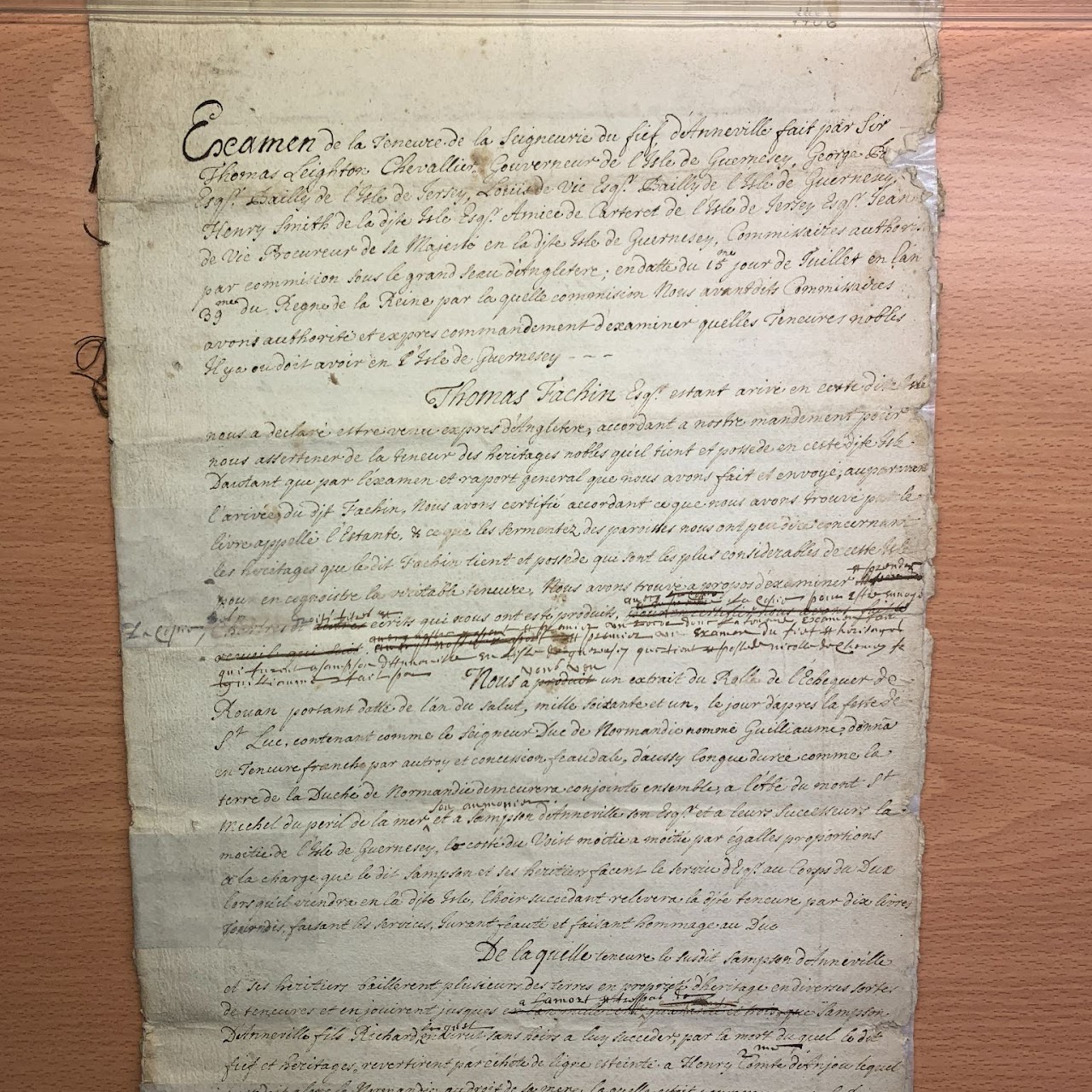
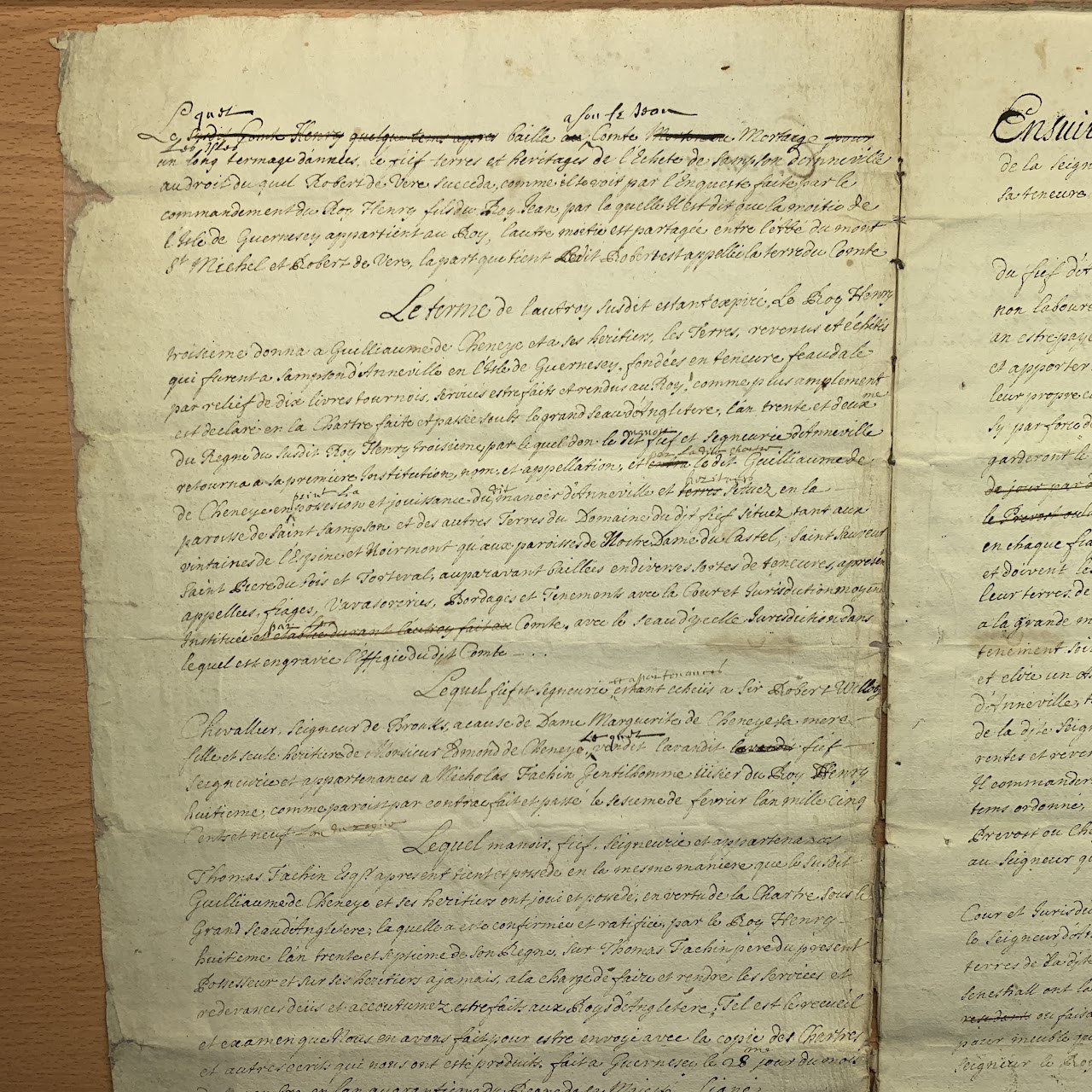
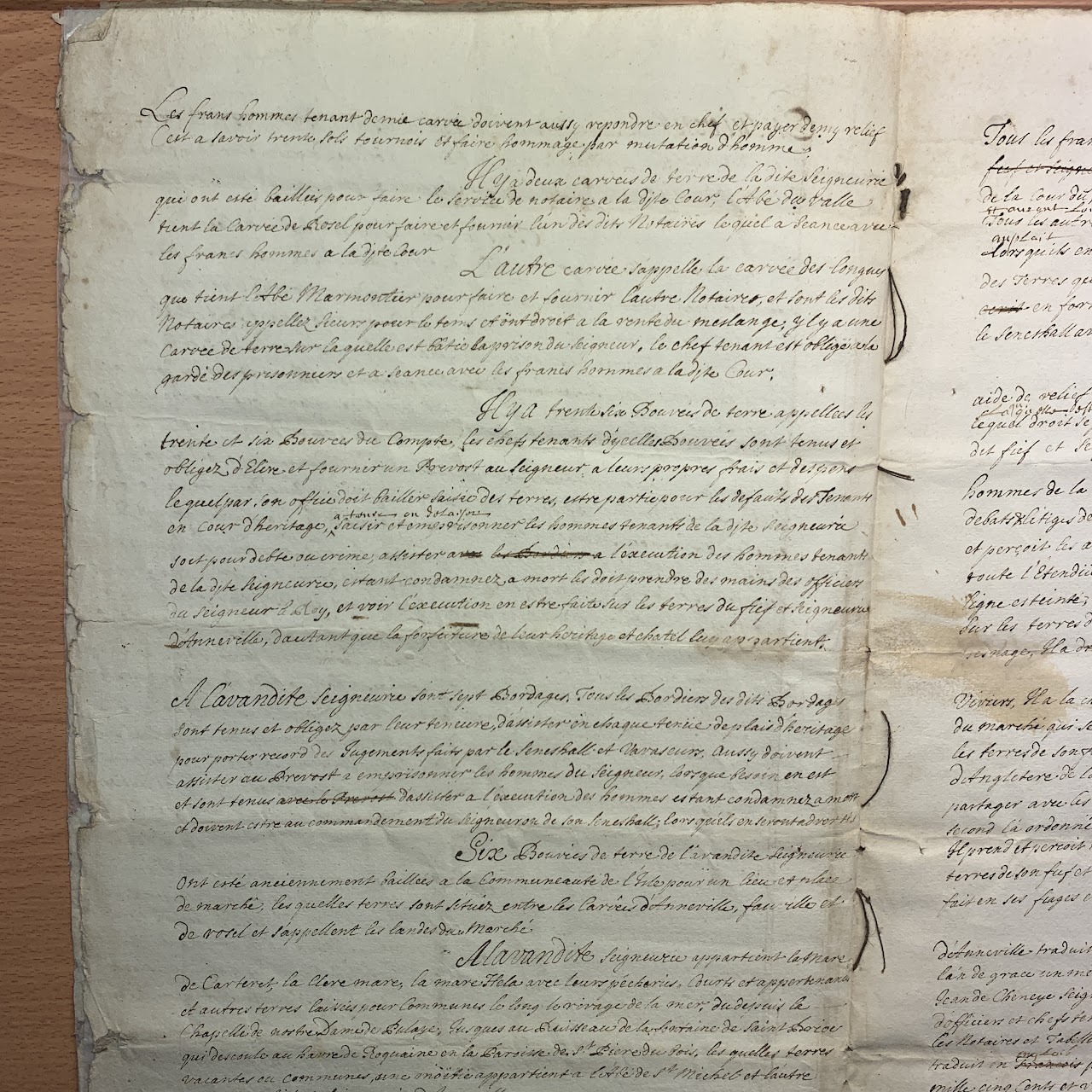
On 15 May 1248 a charter — a formal written grant — gave William de Cheney a yearly payment of £10 tournois (money of the French region of Tours). This charter says nothing about keeping a prison.
An Extente of 1248 — a royal survey recording what the island owed the King — shows that the two carucates of the Fief d'Anneville owed the duty of keeping the King's prison. A carucate is a medieval measure of land; the survey gives no further detail about it. The Fief d'Anneville was a fief — a piece of land with the rights attached to it, held from a superior lord in return for loyalty and services. The survey names no Seigneur, that is, no holder of the fief.
In 1261 a charter of Prince Edward granted Sir William de Cheney free warren — the right to keep and hunt small game on his land — throughout Guernsey. The Garenne d'Anneville survives today as a nature reserve.
The 1248 grant placed William de Cheney in a direct relationship with the Crown. Through female descent the fief later entered the Greville–Willoughby network, creating the dynastic bridge from the medieval de Cheney tenure to the political world of the early Tudors.