Guernsey in this period
Eighteenth- and early nineteenth-century Guernsey is connected to Britain through travel, trade, militia, family networks and the circulation of news.
Thomas Andros was born in Guernsey — one of the Channel Islands, ruled under the Crown but by its own laws — in 1755. His family had long been used to holding both the pen and the sword: the eighteenth-century Andros were advocates, meaning lawyers who argued cases in court, and colonels of the local militia, as their ancestors had been knights. Thomas lived at Normanville, a house on the island, and became Colonel of the Blue Regiment, a militia unit of local men, following his father and grandfather into the same post. In a small island, a family that supplies lawyers and soldiers supplies much of the island's public life.
In 1780, walking in St Peter Port, Guernsey's chief town, with two young ladies, Thomas was insulted by Kenneth Beauvais, a soldier of the island's garrison. The next morning the two men met with pistols. Beauvais was wounded in the arm and chest and died the following day. For breaking the law against duelling, Thomas spent a month in Castle Cornet, the fortress that guarded the island's harbour. A month in a fortress is not a long time, whatever the law books may say.
As an advocate, Thomas carried his clients' complaints against William Le Marchant, the Bailiff — the island's chief judge and leading official — a man of autocratic temper. Le Marchant suspended him from practice, and in 1779 the King in Council, the highest court of appeal for the Crown's islands, declared the suspension illegal. Thomas had beaten the Bailiff himself, and then left the bar for good.
On 6 July 1798 Thomas sailed for Lyme Regis, a small town on the coast of Dorset in England, with his wife Elizabeth, five children, a servant, the household goods and his horse Bess. The crossing took fourteen hours and cost £7 9s 6d. He lived thirty-three years at 14 Church Street in that town, and lies buried opposite the south door of the church, beside a pew he had bought for fifteen guineas. A man who records the price of his pew has kept accounts all his life.
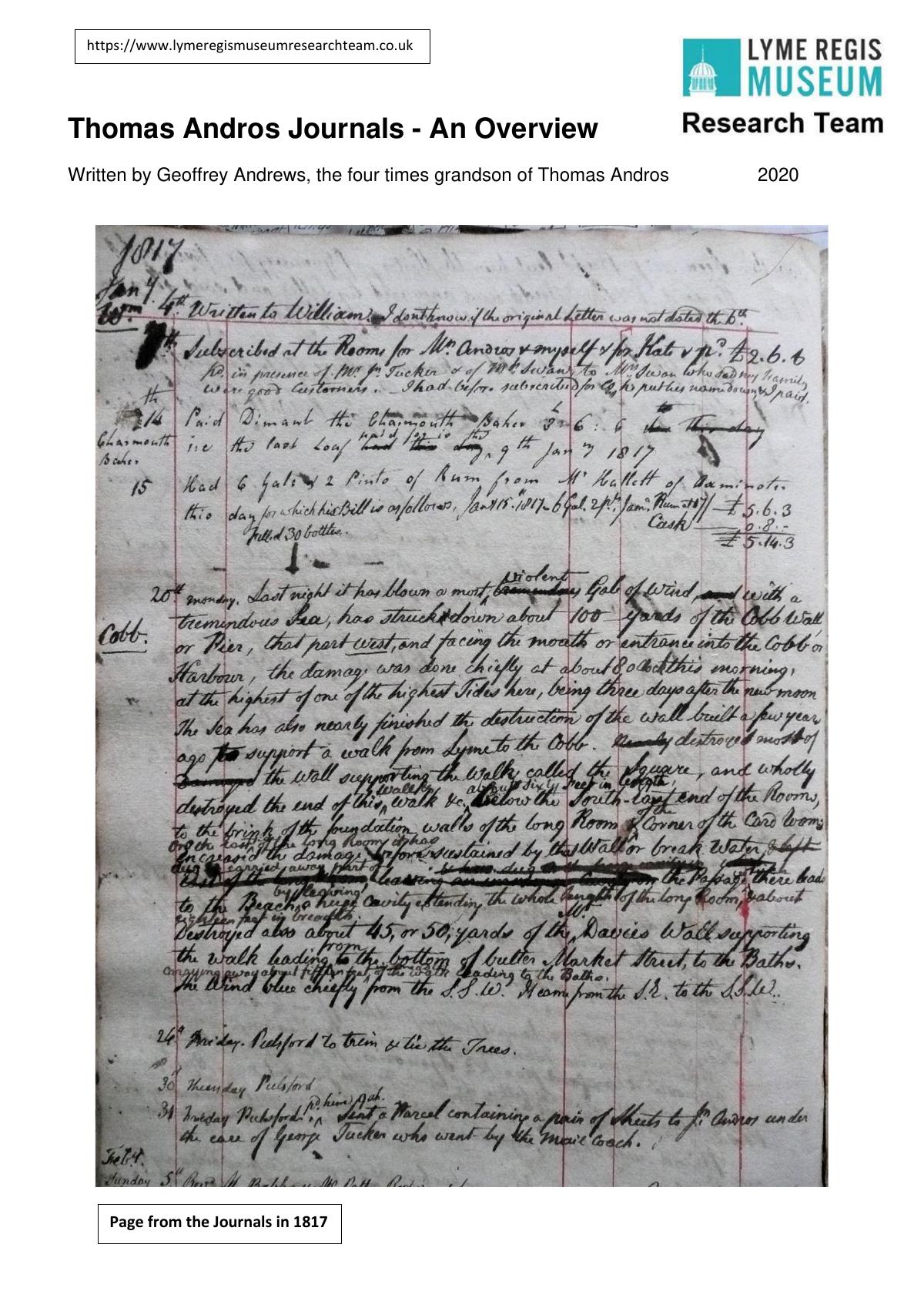
The accounts survive. Thomas's journals run for forty-three years of daily entries, begun in French as a cider account book and continued in English. In 1949 they were given to the Priaulx Library, Guernsey's research library, whose building had been converted for that purpose by his grandson Amias Andros, a civil engineer. A family that had kept the records of a fief ended by giving the island its library.
About these lines: a narrative reconstruction written in the manner of C. Northcote Parkinson (1909–1993), Seigneur of the Fief d'Anneville from 1964 to 1987, historian, and author of the novels of Richard Delancey, a Guernsey sailor. Parkinson did not write them and they are not a historical source. They invent no characters and no speeches: every fact comes from the room above, and words in quotation marks are quoted from the documents cited there.
 Arms associated with Anneville: ermine, a fess gules
The eighteenth-century Andros were advocates and colonels as their ancestors had been knights. Thomas Andros, born in Guernsey in 1755, lived at Normanville and became Colonel of the Blue Regiment, as his father and grandfather had been.
In 1780, walking in St Peter Port with two young ladies, he was insulted by a soldier of the garrison named Kenneth Beauvais. They met with pistols the next morning. Beauvais was wounded in the arm and chest and died the following day; Thomas spent a month in Castle Cornet for breaking the law against duelling.
As an advocate he carried his clients' complaints against the Bailiff, William Le Marchant, a man of autocratic temper. Le Marchant suspended him, and in 1779 the King in Council declared the suspension illegal. Thomas left the bar. On 6 July 1798 he sailed for Lyme Regis with his wife Elizabeth, five children, a servant, the household goods and his horse Bess: fourteen hours at sea, £7 9s 6d. He lived thirty-three years at 14 Church Street and lies opposite the south door of the church, beside the pew he had bought for fifteen guineas.
His journals run for forty-three years of daily entries. He began them in French as a cider account book and continued them in English. They were given to the Priaulx Library in 1949, and the building that keeps them was converted by his grandson Amias Andros, a civil engineer. A family that had kept the records of a fief ended by giving the island its library.
Journals of Thomas Andros, 1788-1831 (Priaulx Library, given 1949); Priaulx Library, 'A sorry tale: the duel between Thomas Andros and Kenneth Beauvais, 1780'; W. Berry, History of the Island of Guernsey (1815), p. 124.In Thomas Andros's Guernsey the courts and the fief papers were written in French, and the people spoke Guernésiais, the island's own form of Norman. The language of the Norman settlers remained the daily speech of the island for centuries after 1204, and French was the official language of Guernsey until 1948.
Eighteenth- and early nineteenth-century Guernsey is connected to Britain through travel, trade, militia, family networks and the circulation of news.
The Lyme Regis journals give Guernsey a rare social archive: family life, servants, gardens, purchases, journeys, militia and current events. They make the island’s history human and connect its seigneurial families to everyday British life.
This dossier tells the story of the fief of Anneville, a piece of land in Guernsey with the payments, courts and other rights attached to it. In 1714 and 1715 a man called Charles Andros acted for his mother, Alix Fashion (also written Fachion), in disputes that came to the Privy Council, the King's council in London, which was the final court of appeal for the Channel Islands. In 1714 one side in the dispute printed a written statement of their case, called a memorial. It argued that Anneville was the principal manor and gave a narrow reading of the words describing which other fiefs depended on it. This was only the argument of one party, not a decision by any court. Two separate documents, dated 12 November 1757 and 14 March 1758, show that Charles Andros was by then Seigneur, the lord of the fief, in a dispute over rents of grain owed on the fief's land. Other documents from this period, including a deed of 1718 handing over property, military commissions and a survey of the fief made in 1758, and the story of who held the fief until 1882, are not included here until the original documents and the identity of the people named in them can be checked.
In 1714 and 1715 there were disputes about the fief of Anneville. A fief is a piece of land, with the payments, courts and other rights attached to it, held from a superior lord in return for loyalty and services. These disputes came to the Privy Council in London, the King's council and the final court of appeal for the Channel Islands. In these disputes we must keep three things apart: the parties who were arguing, the written statements they made to support their case, and the decisions the courts actually made. One written statement of 1714 set out an argument for one side only; it was not itself a judgment.
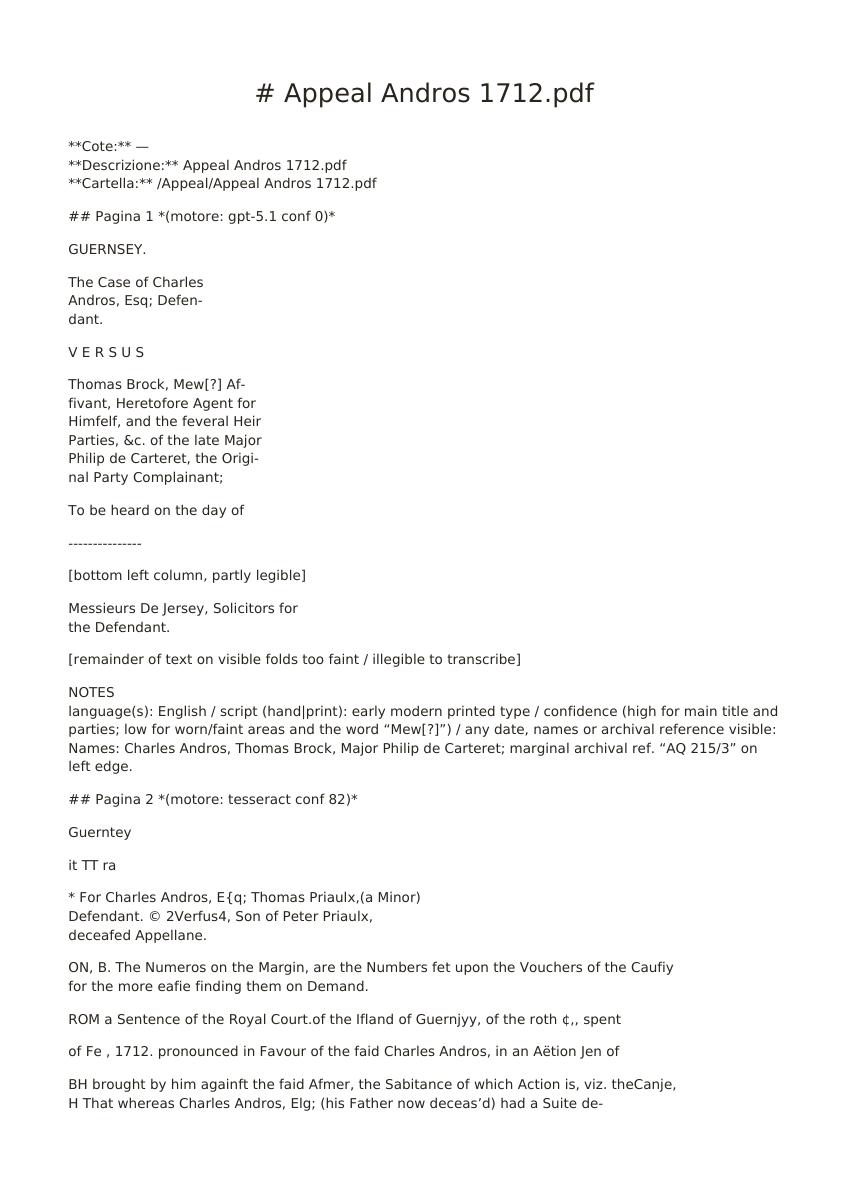
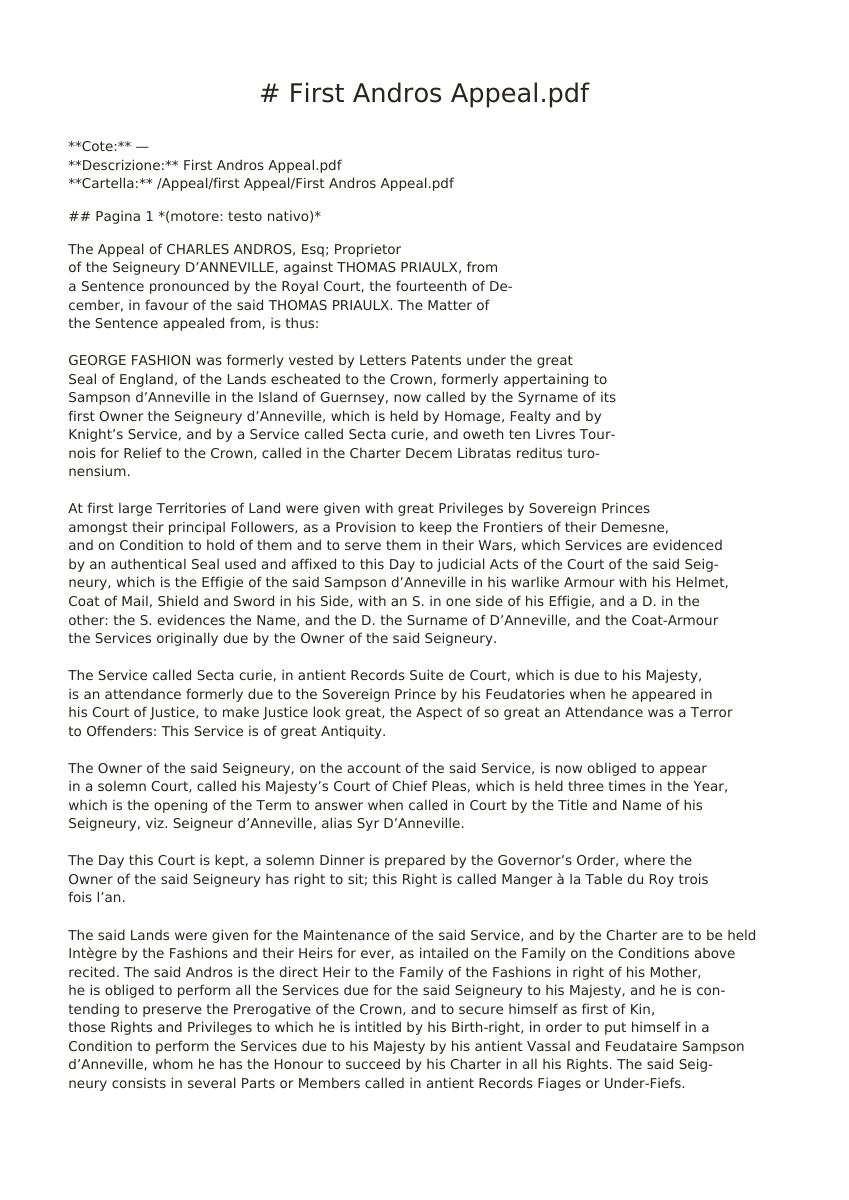
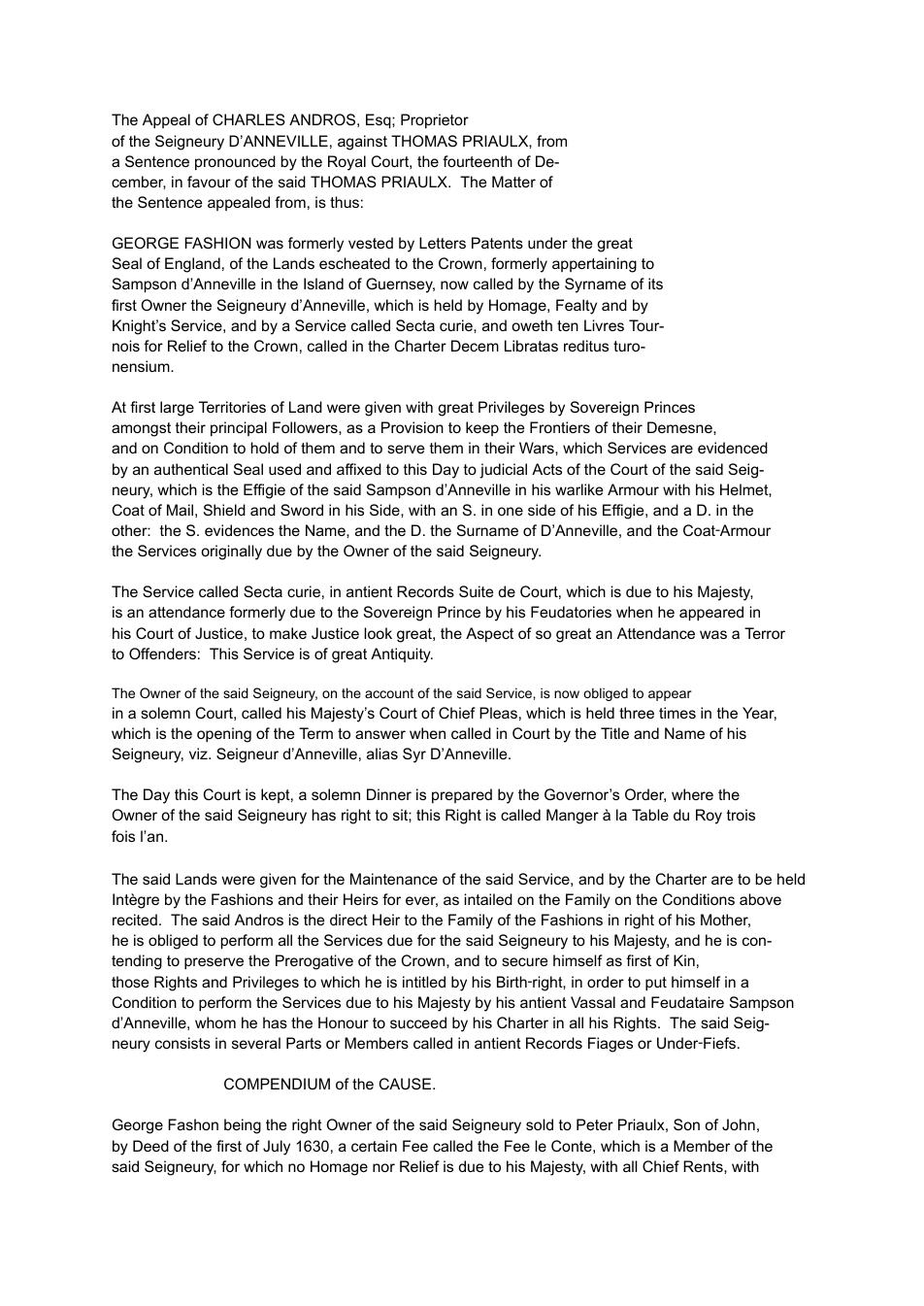
In 1714 Charles Andros, acting for his mother Alix Fashion, supported a written statement of his side's case, called a memorial. In it, his party argued that Anneville was the principal manor, and it read narrowly the words that said which other fiefs depended on Anneville. A fief could be held not directly from the Crown but from another fief; the holder of the lower fief then owed homage, the formal promise of loyalty, and dues to the holder of the higher one. To say that a fief 'depended' on Anneville meant exactly this. The memorial was a legal argument, not a judgment: no court had decided that what it said was true.
Two separate documents, dated 12 November 1757 and 14 March 1758, show how the fief was run in ordinary times. They concern a dispute over rentes, yearly payments of grain owed on the fief's land. By then Charles Andros was Seigneur, the lord of the fief. The documents show the Seigneur, his provost, the grain rents, a judgment and an appeal. They are two distinct moments in the story, and nothing is added here about who held the fief afterwards or how the holders were connected.
Between 1758 and 1882 only a few records of who held the fief of Anneville survive. Putting these surviving records side by side shows both the continuity of the lordship and the long stretches of time for which no documents remain.
The printed statement of the Andros case of 1714, called the Andros Printed Case, is valuable because it preserves a legal theory argued in a real lawsuit. It is the case of one party, not a decision of a court. To prove what it claims, one would need a judgment, an agreement between the parties, or a deed handing over the rights in question.
In 1714 and 1715, Charles Andros acted for Alix Fashion (also written Fachion), who was the mother in the case and the owner of the Manor d'Anneville. He brought appeals for her to the Privy Council — the King's council in London, which was the final court of appeal for the Channel Islands — against Andrew Monamy and Thomas Priaulx.
The written argument prepared for the 1714 appeal claimed that Anneville was the principal manor, and it read the wording about which other fiefs depended on it more narrowly than the deed of sale did. To say a fief 'depended' on another meant that the holder of the lower fief owed homage and dues to the holder of the higher one.
On 12 November 1757, Charles Andros, described as the qualified Seigneur of the Fief d'Anneville — that is, the lord holding the fief, a piece of land with the rights attached to it — spoke on behalf of David Le Normand, the man against whom the case was brought. The case had been brought by Ezechiel Robin, who claimed two bushels of a yearly payment (rente) owed in grain.
On 14 March 1758, a judgment against Charles Andros, again described as the qualified Seigneur of the Fief d'Anneville, was confirmed on appeal in the same dispute over the two bushels of the yearly payment in grain. So the court decided against Andros, and a higher court agreed with that decision.
In the Andros Printed Case, a printed legal argument, Anneville is presented as the head manor, the chief manor to which other fiefs were subordinate. The document speaks of these subordinate fees, meaning the smaller fiefs held under it. This wording shows what the Andros side asserted, and it places the named dependent fiefs within the same legal case.
An agreement, or a schedule (a list attached to a legal document), that names several fiefs together shows that those fiefs were dealt with in the same legal arrangement and belonged to the same territory.
Thomas Andros (1755–1831), Seigneur d’Anneville, kept three journals from 1788 across forty-three years. They record family, servants, garden, purchases, journeys, news, duels, militia and recipes: an exceptional window onto daily life behind the title.
The family archive opens onto medicine, gardens, politics, military service, law and even a fatal duel. These stories make the long Andros tenure a sequence of individual lives rather than a blank genealogical interval.
First Andros Appealdocument1714 · Open documentAndros Appeal and Printed Casedocument1712 · Open documentFirst Andros Appeal - archive copydocument1714 · Open documentThomas Andros journals: the Lyme Regis yearsprivate-life1788–1831 / research overview 2020 · Open documentDaily life of Thomas Andros, Seigneur d’Anneville, and his family at Lyme Regis Not dated.‘The Appeal of Charles Andros, Esq; (AQ 0012/05-01)archive · Open documentNot dated.‘The Appeal of Charles Andros, Esq;Sources: SG 39-09/04 — Andros appeal for Alix against Monamy | AQ 0012/05-03 — Andros brief against Priaulx Ca (AQ 0012/05-03)archive · Open documentYet in 1677 Peter Priaulx himself signed Articles naming the disputed fiefs "members and dependant of the said (AQ 0012/13-01)archive · Open document14 March 1758, Charles Andros, Seigneur of Fief… (AQ 0096/10-12)archive14 March 1758 · Open document14 March 1758, Charles Andros, Seigneur of Fief…12 November 1757, Charles Andros, Seigneur of Fief… (AQ 0096/10-14)archive12 November 1757 · Open document12 November 1757, Charles Andros, Seigneur of Fief…